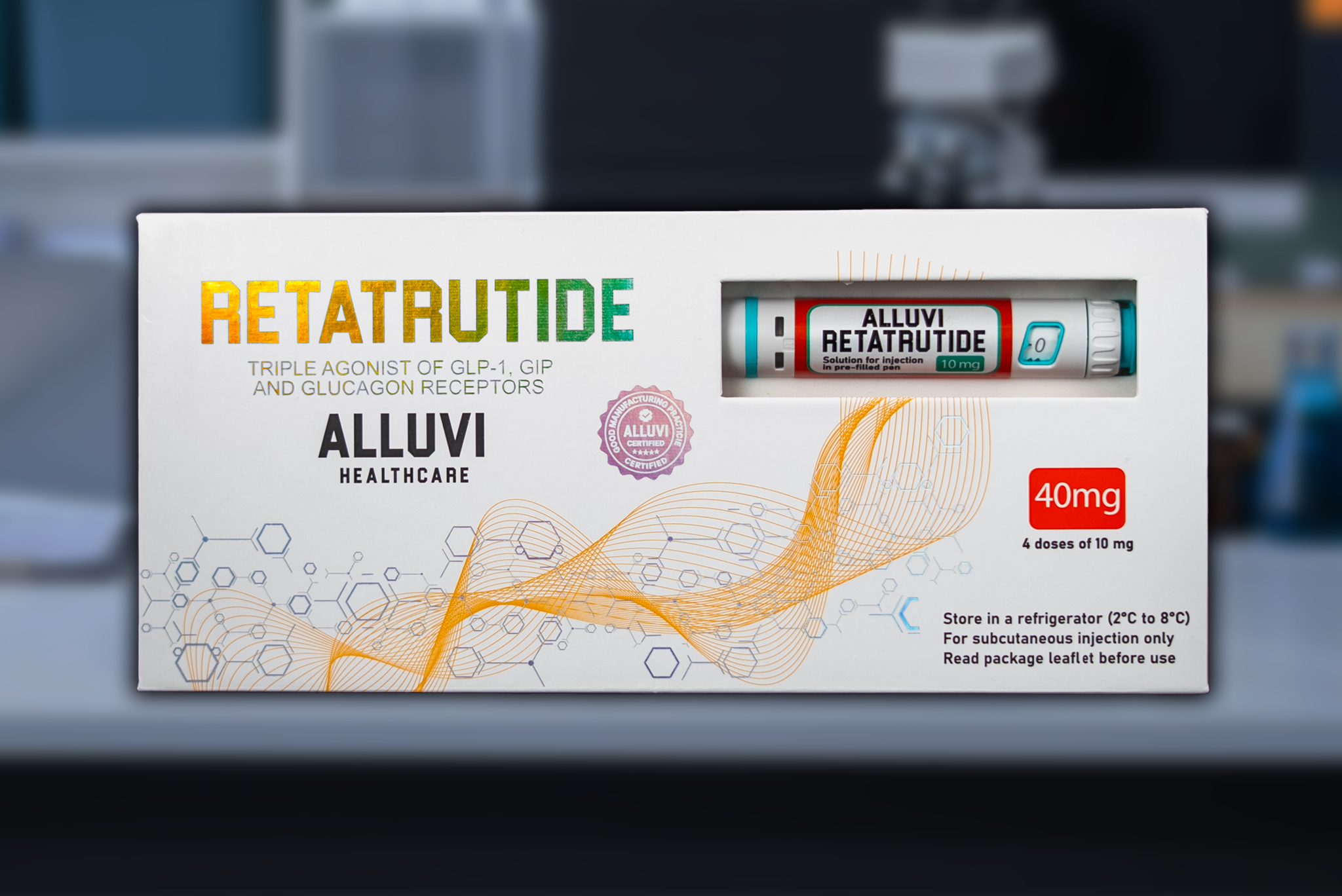
Alluvi Retatrutide product overview
Alluvi Retatrutide is supplied as a research formulation containing an investigational peptide studied for its activity across three receptor pathways: GLP-1, GIP and glucagon. This product is supplied in a sealed, pre-filled research device for controlled laboratory evaluation, formulation analysis, stability testing and research handling.
The information below outlines the supplied format, why Retatrutide is of research interest and the main areas commonly discussed in scientific study.
What is included?
- Retatrutide: 40mg
- One sealed, pre-filled research device
- Fixed-volume research format
- Store refrigerated between 2°C and 8°C
- Do not freeze
- Research and development use only
Why is Retatrutide studied?
Retatrutide has attracted research interest because it is described as a triple agonist, meaning it is studied in relation to three distinct receptor systems rather than one. Researchers investigate how these pathways may interact in controlled models involving metabolic signalling, energy regulation and peptide pharmacology.
Common areas of laboratory interest
- GLP-1 receptor pathway research
- GIP receptor pathway research
- Glucagon receptor pathway research
- Triple-agonist signalling analysis
- Metabolic pathway investigation
- Energy-regulation models
- Formulation stability and degradation studies
- Delivery-format and handling evaluation
How the three receptor pathways are studied
GLP-1 receptor pathway
GLP-1-related research commonly examines signalling associated with glucose regulation, appetite pathways and metabolic response. In Retatrutide research, GLP-1 activity is considered as one part of a broader multi-receptor profile.
GIP receptor pathway
GIP-related research investigates incretin signalling and its relationship with metabolic pathways. Researchers may examine how GIP activity interacts with GLP-1 and glucagon signalling in a combined agonist model.
Glucagon receptor pathway
Glucagon-related research focuses on energy balance, hepatic signalling and metabolic regulation. Within triple-agonist studies, this pathway is evaluated alongside GLP-1 and GIP activity.
How the formulation may be evaluated
Laboratory evaluation may focus on the formulation's stability, temperature sensitivity, visual characteristics, delivery-device behaviour and compatibility with analytical testing procedures.
Researchers may also study receptor-binding profiles, degradation patterns and the behaviour of the compound under controlled storage and handling conditions.
Reported research interests
The following topics describe areas in which Retatrutide or related receptor pathways are commonly discussed in scientific research. They are not claims of treatment, clinical effectiveness or suitability for personal use.
- Metabolic signalling research
- Appetite-pathway models
- Energy-balance investigation
- Body-composition research models
- Glucose-regulation pathway studies
- Multi-receptor agonist analysis
- Peptide formulation and stability research
Storage and handling
Keep the product refrigerated between 2°C and 8°C. Retain it in the original sealed packaging until required for controlled laboratory evaluation. Do not freeze.
Handle only under suitable laboratory procedures, with appropriate documentation, temperature control and research protocols.
Frequently asked questions
What does the Retatrutide research pen contain?
It contains 40mg Retatrutide in one sealed, pre-filled research device.
Why is Retatrutide called a triple agonist?
It is studied for activity involving GLP-1, GIP and glucagon receptor pathways.
What is the product supplied for?
It is supplied for controlled laboratory research involving receptor pathway analysis, formulation stability, delivery-format evaluation and research handling.
Is Retatrutide intended for human or veterinary use?
No. It is sold strictly for research and development purposes only and is not intended for human or veterinary use.
How should it be stored?
Store refrigerated between 2°C and 8°C. Do not freeze.
Are analytical reports available?
Available documentation can be viewed on the Laboratory Reports and COAs page.
Continue Retatrutide research
For a broader educational overview of the investigational compound, triple-agonist terminology and evidence context, see our What is Retatrutide? research guide. For published-study context, visit the Retatrutide clinical trials overview.
Related research guides
Research-use disclaimer
All products supplied by Pembrokeshire Research Solutions are sold strictly for research and development purposes only.
They are not medicines, are not intended for human or veterinary use and must be handled only within appropriate research environments.
The research topics listed on this page describe areas of scientific investigation and should not be interpreted as medical advice, treatment guidance or claims of clinical benefit.