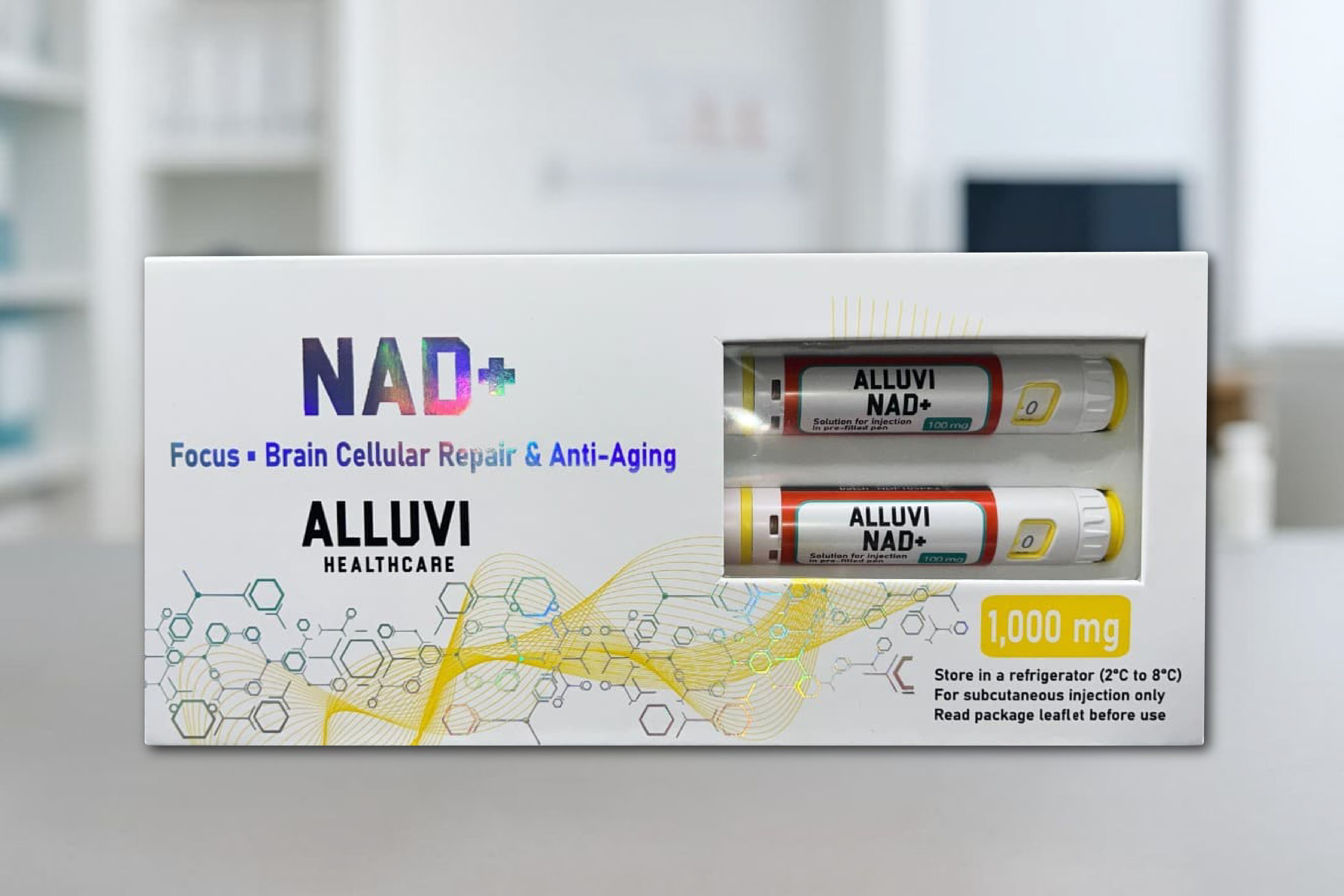
Alluvi NAD+ product overview
Alluvi NAD+ contains Nicotinamide Adenine Dinucleotide, a naturally occurring coenzyme involved in numerous cellular processes. This product is supplied in two sealed, pre-filled research devices for controlled laboratory evaluation, formulation analysis, stability testing and research handling.
The information below outlines the supplied format, why NAD+ is of research interest and the main areas commonly discussed in scientific study.
What is included?
- Total NAD+: 1000mg
- Two research devices: 500mg each
- Sealed, pre-filled research format
- Store refrigerated between 2°C and 8°C
- Do not freeze
- Research and development use only
Why is NAD+ studied?
NAD+ is studied because it participates in cellular redox reactions and enzyme-linked pathways associated with energy metabolism, mitochondrial function and cellular signalling. Researchers investigate how NAD+ levels, turnover and related biochemical pathways behave under controlled laboratory conditions.
Common areas of laboratory interest
- Cellular energy metabolism
- Mitochondrial pathway research
- Redox-reaction investigation
- Enzyme-linked signalling pathways
- Oxidative-stress models
- Cellular ageing research models
- Formulation stability and degradation studies
- Delivery-format and handling evaluation
What NAD+ does in cellular research
Redox reactions
NAD+ and NADH form a redox pair used in biochemical reactions involving the transfer of electrons. Researchers examine this relationship when studying cellular metabolism and energy-producing pathways.
Mitochondrial research
NAD+-dependent reactions are relevant to mitochondrial metabolism. Laboratory studies may investigate how changes in NAD+ availability relate to mitochondrial function, energy balance and cellular response.
Enzyme-linked pathways
NAD+ is used by several enzyme families, including sirtuins and PARPs. These pathways are studied in relation to cellular signalling, DNA-damage responses and metabolic regulation.
How the formulation may be evaluated
Laboratory evaluation may focus on the formulation's stability, temperature sensitivity, visual characteristics, delivery-device behaviour and compatibility with analytical testing procedures.
Researchers may also examine degradation patterns, concentration consistency and the behaviour of NAD+ under controlled storage and handling conditions.
Reported research interests
The following topics describe areas in which NAD+ or related biochemical pathways are commonly discussed in scientific research. They are not claims of treatment, clinical effectiveness or suitability for personal use.
- Cellular energy-pathway research
- Mitochondrial function investigation
- Oxidative-stress models
- DNA-damage response pathways
- Sirtuin-related research
- Metabolic signalling studies
- Cellular ageing research models
- Formulation and delivery-device research
Storage and handling
Keep the product refrigerated between 2°C and 8°C. Retain it in the original sealed packaging until required for controlled laboratory evaluation. Do not freeze.
Handle only under suitable laboratory procedures, with appropriate documentation, temperature control and research protocols.
Frequently asked questions
What does the NAD+ research kit contain?
The kit contains a total of 1000mg NAD+ across two sealed, pre-filled research devices containing 500mg each.
Why is NAD+ studied?
NAD+ is studied because of its role in redox reactions, cellular energy metabolism, mitochondrial pathways and enzyme-linked signalling.
What is the product supplied for?
It is supplied for controlled laboratory research involving formulation stability, cellular pathway analysis, delivery-format evaluation and research handling.
Is NAD+ intended for human or veterinary use?
No. It is sold strictly for research and development purposes only and is not intended for human or veterinary use.
How should it be stored?
Store refrigerated between 2°C and 8°C. Do not freeze.
Are analytical reports available?
Available documentation can be viewed on the Laboratory Reports and COAs page.
Related research guides
Research-use disclaimer
All products supplied by Pembrokeshire Research Solutions are sold strictly for research and development purposes only.
They are not medicines, are not intended for human or veterinary use and must be handled only within appropriate research environments.
The research topics listed on this page describe areas of scientific investigation and should not be interpreted as medical advice, treatment guidance or claims of clinical benefit.